Curiosity#
For the past one month, i have been planning to get a telescope and really want to explore our space, i was curious on two things from childhood one is what is underneath and what is above us, there is no easy way for me to explore all these in my child hood days or even cllg or school days due to financial reasons, now am at 30 doing my SDE work, having a stable income, now i want to explore all these child hood things in my life, one of these is to basically get a telescope and watch the moon up close with my own eyes.
What is Telescope#
When i decided to get a telescope for myself, i basically had 0 idea on how to select one, what are all the types, how to know which is best, where to purchase etcc… So i before making the buy, i started to learn about what is telescope, how its working, what are its internals, blah blah. To start with,
-
What is Telescope really? [is it a giant cylinder object, or is it a zoom that we have in our smartphone camera]
-
The basic role of a telescope is to
collect more light into some object(mostly cylindrical object)andthen magnify that image for closer viewing to the eyes. -
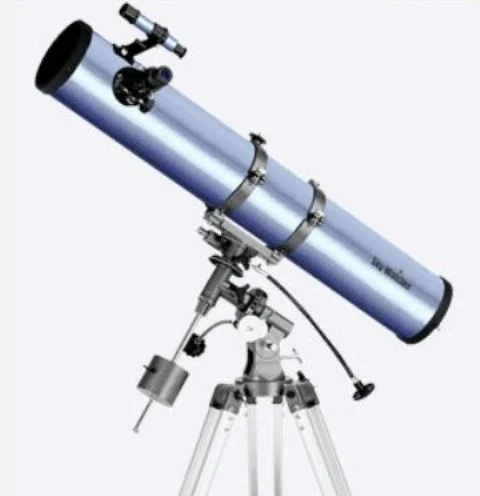
Telescope is of cylindrical in shape and comes with two types 1. Refraction(lenses) and 2. Reflection(mirrors).
-
Some Terminologies#
Before moving to know about what is Refractor or Reflector Telescope, lets know about some of the terminologies that are used in telescopes.
Focal Length#
In simple terms, focal length is the distance from any lens to the focus point, simple analogy could be
take a magnifying glass and hold it in ur hands under the sun, now the sunlight will hit the magnifying glass
on top and then the light will bend on the other end and then hit over the ground, the point
where it hits over the ground is called the focus point, the distance from the lens(magnifying glass)
to the focus point is called Focal Length.
Why it happens: if you think about it, light travels only at straight line. you could have seen this while lighting a torch or any light, now when this straight line light hits any mirror or lens it bends from the original straight position, this bending decides how far the focus goes.
EyePiece#
Eyepiece is the exact tool, that maginifies the image/light from the telescope to your eyes. the actual light/image that falls inside the telescope tube(will tell u about this later down below) will be so so small like 1cm or even mm or even null, and the Eyepiece is the one which redirects that light into multiple lenses places inside the eyepiece and then transmits into our naked eye.
How Eyepiece works?#
Eyepiece are usually called by 10mm, 12mm, 6mm, 25mm etc.. the shorter mm usually has more magnification(zoom), the longer mm usually has less magnification but more clarity. how this magnification works -> eyepiece has multiple lenses(usually curved based on the type), the amount of wider light that the eyepiece bends determines its magnification, the higher will be result of more magnified image(zoomed), the lower(the narrower) will be less magnified. consider the below analogy
Person A (25mm): Points the light at you from far away. The beam is narrow when it hits your eye.

Person B (10mm): Stands right in front of your face and shines the light. Even though it's the same flashlight, the light "fills" your vision because the angle is so wide.
basically the shorter eyepieces bends the light alot, these lights/rays enter our naked eye in a wider way, so we see the zoomed kinda image the longer eyepieces bends the light less, these enter our naked eye in a narrower way, so we see a less zoomed image compared to shorter one.
the number before the mm 25 | 10 | 6 is the focal length of the eyepiece, its the same that i mentioned above
the distance between the first lens that collects the light/ray from the telescope and the final image that the eyepiece
formed to view.
Lens#
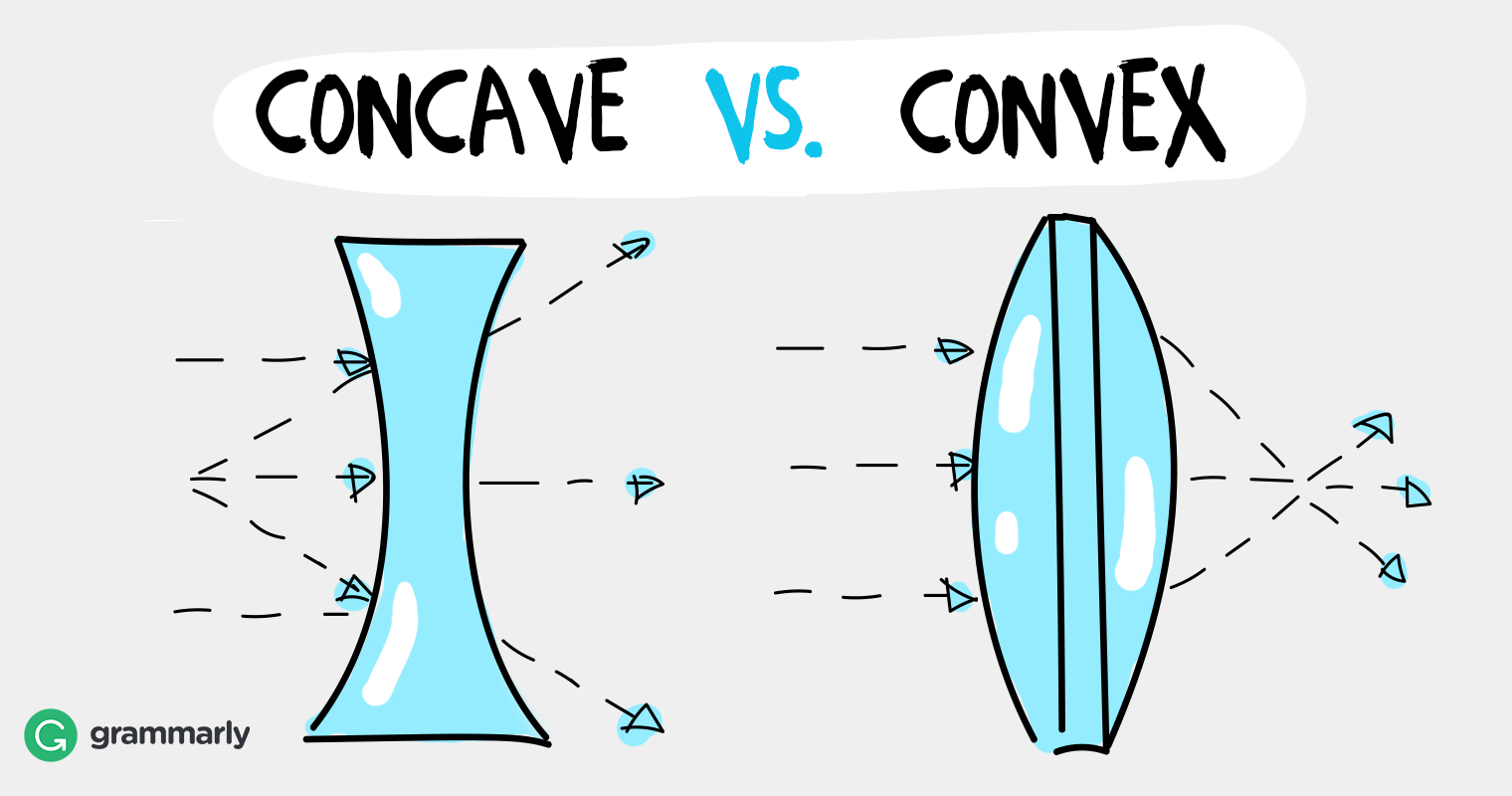
Lens is an object that allows light/rays to pass through it, and bend the incoming light/rays as they enter. Generally lenses are of two categories. 1. concave and 2. convex
Concave: concave is usually thinner at the center and thicker at the edges, and it spreads out the incoming light. Convex: convex is exactly opposite to the above thicker at the center and thinner at the edges, where it bends the incoming light towards inward into a certain point.
Mirror#
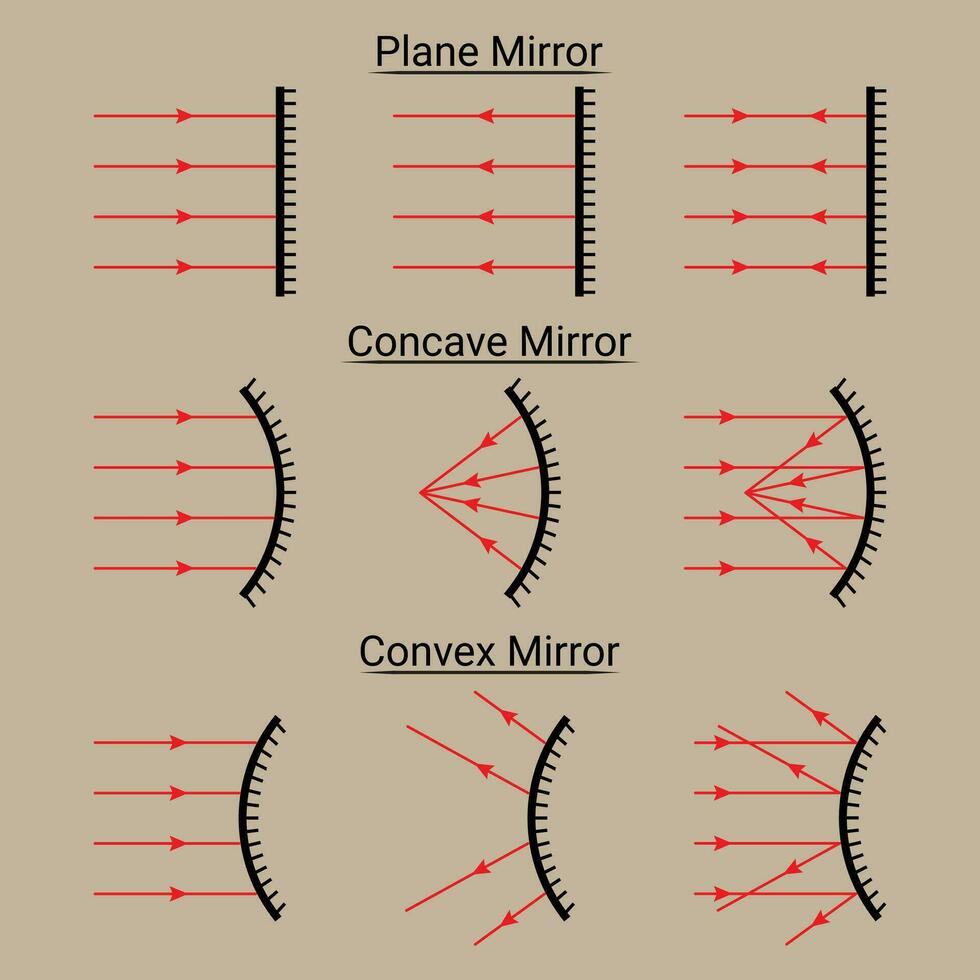
As we already know Mirror just reflects back the light off its surface, in telescope we do have two like concave, flat, curved mirrors.
concave mirrors would be curved inward like a bowl, where it reflects all the light that it gets towards a central point. concave mirrors are typically used as the primary mirror on telescopes(especially on the reflector telescope).
Core of telescope#
The core work of telescope is to collect light from a distant object and concentrate it into a small area, so that
our eyes can able to see that object, there are two primary telescope’s right now which does this job for us.
Refractor Telescope#
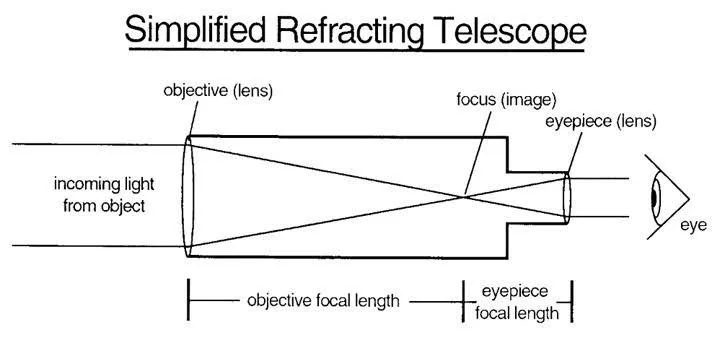
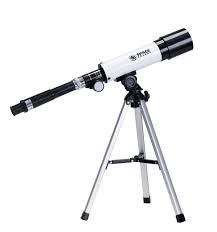
Refractor telescope if the first type of telescope to be founded by Galileo. It consists of a long tube where in the front
of the tube has primary lens to collect light of the object that is being pointed on and then send that light to the bottom of the
eyepiece.
- How it works: Light enters the front lens(Objective Lens), which is of curved type(Convex), the incoming rays into the tube converge and meet at a single point(focus point) inside the tube.
- The eyepiece: The eyepiece on refractor telescope usually sits on back of the tube, takes that tiny focused image(from the focus point) and magnifies into our eye.
Reflector Telescope#
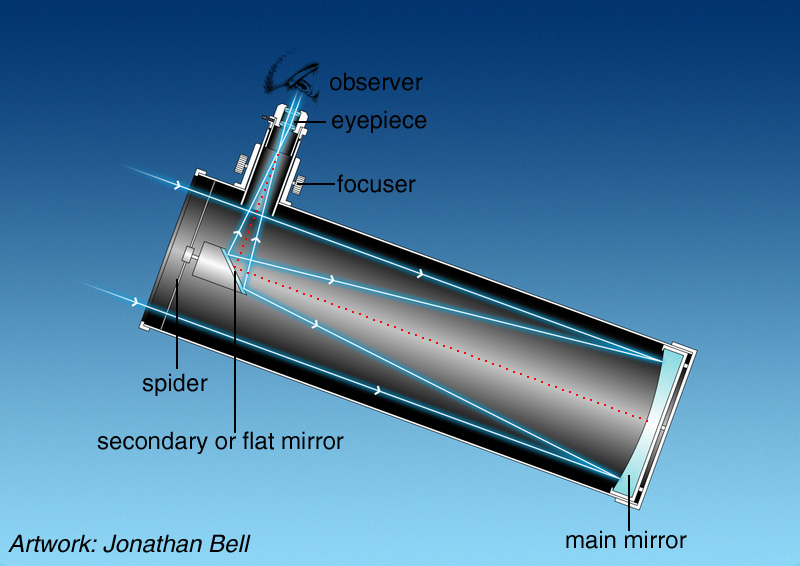
Reflector telescope is the second one to be invented by Newton(its also called newtonian telescope), this telescope
mostly uses mirrors instead of lenses, and also the eyepiece won’t be at the end of the tube, instead it would be at the side
of the tube at top, which makes it easy to use in terms of viewing.
How it works: This telescope also a cylindrical tube, where on top u have a opening and at the last bottom of the tube u
have a large curved mirror, this mirror basically collects light from the top opening and then reflect that light
to the secondary mirror(angled at 45degree to the eyepiece) on the top.